




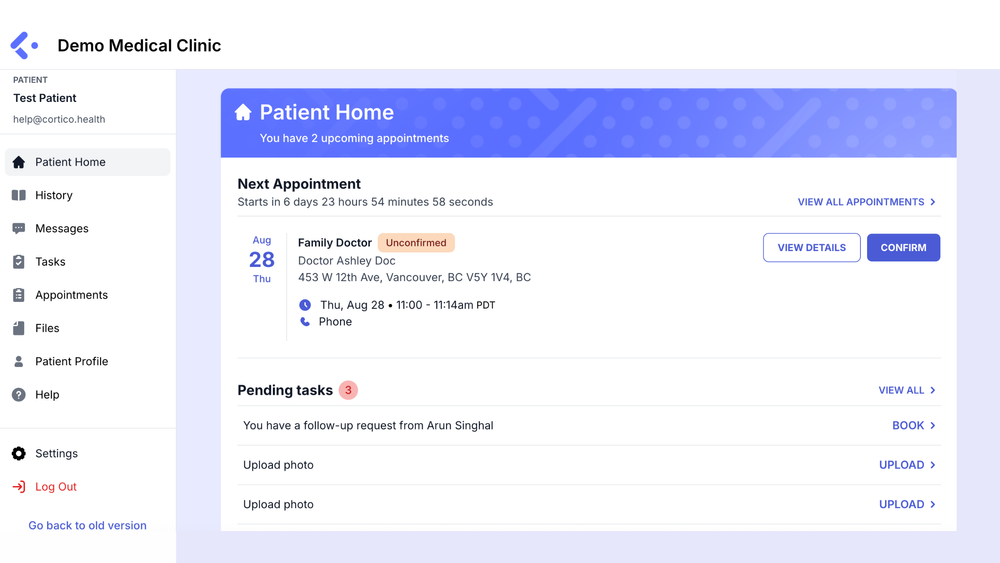
Every month, over 300,000 patients book appointments, complete intake forms, fill prescriptions, and manage their care online through Cortico—without a single phone call to the front desk.
That’s not a prediction about the future of healthcare. It’s what happened throughout 2025.
As we move into the New Year, we wanted to take a moment to reflect on what we’ve achieved together. Because while Cortico built the platform, it’s the forward-thinking providers across North America who had the courage to reimagine how care is delivered.
Here’s how giving patients the ability to manage their care online unfolded throughout the year.
2025 By the Numbers
In 2025, clinics using Cortico collectively:
- Facilitated over 3,000,000 patient appointments. More than 300,000 appointments every month are managed online, reflecting sustained growth and deep adoption across practices of all sizes.
- Processed 700,000+ prescriptions. 60,000+ prescriptions are sent securely to pharmacies each month, validating a digital-first prescription workflow for hundreds of clinics.
- Registered 25,000+ new patients digitally every month. Clinics (and patients) increasingly prefer a digital registration and intake system, eliminating manual data entry and freeing staff to focus on patient care.
- Embraced our new Patient Portal, accessing it over 450,000 times per month. Launched this summer, the portal helps patients manage their care more easily and further reduces inbound phone volume for clinics.
On a practical level, these numbers reflect a growing ability for clinics to completely phase out phone-based scheduling and care management, moving to 100% online booking.
The Lesson: Adoption Is Key
If there’s one thing 2025 has taught us about healthcare workflow automation, it’s that adoption is the most important metric.
The breakthroughs our partners have achieved aren’t due to the technology alone. It’s the thoughtful implementation of online tools—often combined with adjusting or re-designing workflows—to create systems that patients and providers actually enjoy using.
Elegant digital workflows like this are what helped providers like Dr Sarah Baldwin save 20 hours per week and finally stop working on her days off. They enabled Maywood Medical to transition entirely to online booking. And they allowed Dr Andy Minhas to increase volume in his clinic to 250+ patients per day, while still leaving for home on time every day.
Why Now Is the Time for Action
Even with recent advances in AI, Physicians across the US and Canada continue to struggle with excessive administrative burden. Furthermore, studies continue to confirm what we all already know—that the crushing weight of this (largely unpaid) admin time is driving the burnout crisis among the health workforce.
Addressing the entrenched issues around administrative burden and burnout requires a different approach to the efficiency lens through which these crises are typically viewed. We won’t solve these problems by “tweaking” existing broken workflows. The way providers deliver care must be reimagined.
By empowering patients to manage routine care tasks independently, we can entirely remove a significant portion of daily tasks that divert providers from doing their most important work.
That’s the vision Cortico was built to support. In 2025, that vision became an operational reality for hundreds of practices across Canada and the United States.
Looking Ahead to 2026
Cortico’s focus for the coming year remains unchanged: deepen EMR integrations, expand automation capabilities, and continue building the digital infrastructure that supports both clinic operations and patient experience.
You can expect advancements in our EMR integrations (including Epic, Oracle Health, AdvancedMD, and Practice Fusion), expanded communication tools, and enhanced support for clinics as they scale to increase access to care. We’re also piloting new features in secure provider-to-provider messaging and intelligent workflow triggers that we’re excited to roll out broadly in 2026.
But more than anything, we’re energized by the opportunity to continue serving the clinics and patients who are reshaping the modern healthcare experience.
